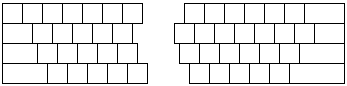
The Dvorak keymap was invented by August Dvorak (not Antonín Dvořák, and not John C. Dvorak), to improve on the ineffecient QWERTY keymap. It looks like this:
  `~  1!  2@  3#  4%  5^  6^      7&  8*  9(  0)  [{  ]}  \|
        '"  ,<  .>  p   y        f   g   c   r   l   /?  +=
          a   o   e   u   i        d   h   t   n   s   -_
            ;:  q   j   k   x        b   m   w   v   z
Or with the shift-[Char] items taken out:
   `  1   2   3   4   5   6       7   8   9   0   [   ]   \
        '   ,   .   p   y        f   g   c   r   l   /   +
          a   o   e   u   i        d   h   t   n   s   -
            ;   q   j   k   x        b   m   w   v   z
(That's the split-keyboard version.)
Notice that the vowels are in a line on the left, and that high-frequency consonants spread out from the right-center. There are other patterns to be found in the clever design.
I switched to using a Dvorak keymap in about 1997, and it's been happytime ever since! Specifically: without the switch, I would have developed (instead of basically eliminating) serious RSI, which would have halted my vocation and avocation for my writing and programming.
People who want to switch to Dvorak (typically because they hear, correctly, that it'll likely help their RSI / CTS) often ask me for advice. After a while I decided to type up my learning tips on this web page, here.
the and to of a he was I in you that his it with for on as had at but be all her him not they me were out is by have up like about this so do from one an she get don't or if old when just which their said know been good what them we some go got man into would think did who going now down there my more could your right little no these want any are can time how see way never say here business over back it's much house day too men other than come home always lot evening two tell went thing only being off after make wife while room away himself night before real then through wellMake sentences out of them, and practice. Learning to touch-type the common words is half of the task of learning Dvorak.
· One thing I've found very effective is to give up regular caffeine intake. Caffeine increases muscle tension, and that makes for unnecessary (and therefore harmful) strain in typing.
· RSI braces (available for about $60/pair at a local pharmacy) are often very useful. Many people find them best to wear while tying, while many others find that they should not be worn while typing, but are beneficial at other times, esp. when you're asleep.
· Others swear by stretching exercises for your arms. See the aforementioned faqs.
· If you think you might be getting RSI/CTS, you really should go see a doctor for a consultation, and sooner rather than later— especially if you get weird cold or tingling sensations in your hands, and especially if your hands feel oddly numb at times. Really, it's a bother to go visit the doctor, but your hands are at stake here!